
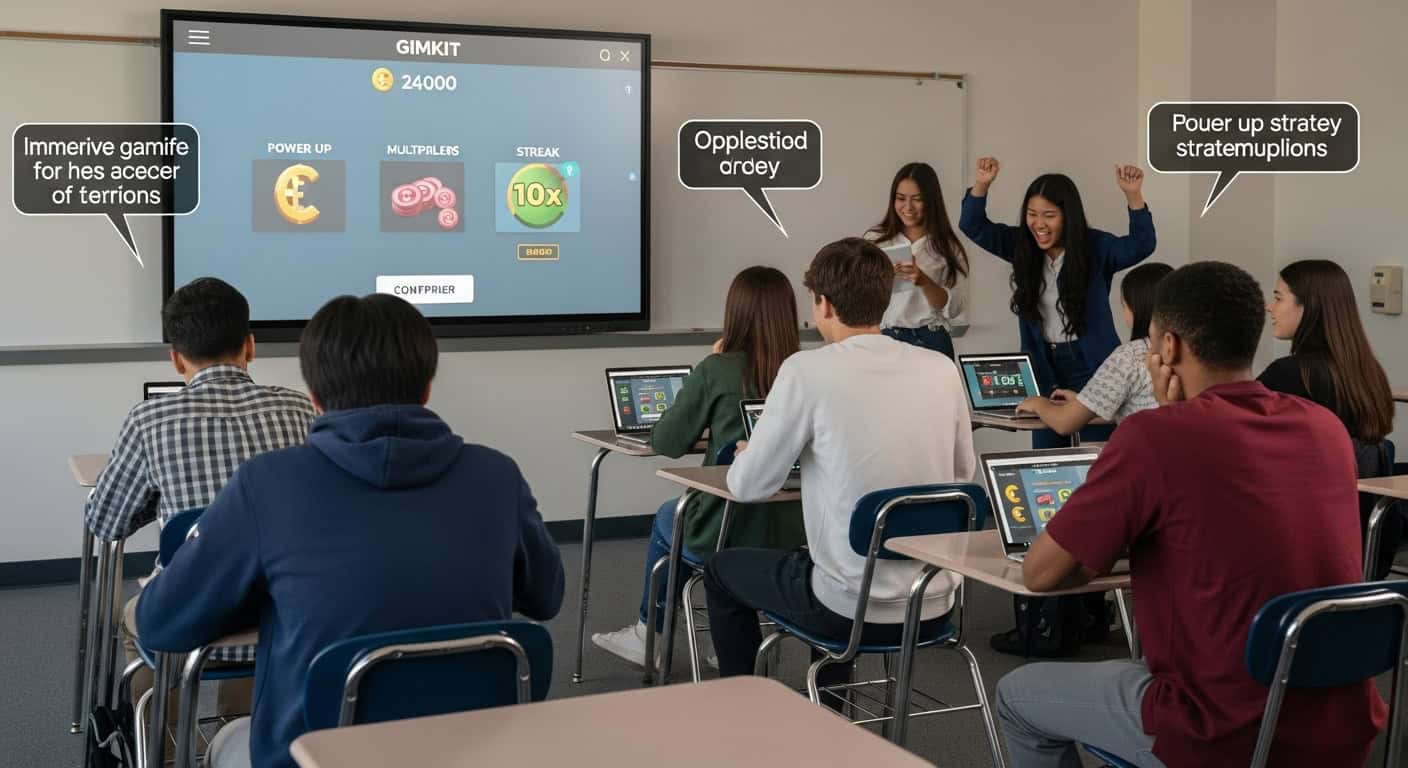
I’ve been teaching high school since 2012. In that time, I’ve watched Kahoot rise and fall, Quizlet Live come and go, Nearpod get expensive, Pear Deck become mandatory, then forgotten, and about a dozen district-mandated platforms collect dust in my bookmarks bar.
Gimkit is the only one still open in my browser every single week, sometimes every single day.
Not because it’s perfect. Not because it has the most features. But because it’s the only tool that consistently turns thirty bored, phone-addicted teenagers into kids who beg me to keep the game going when the bell rings.
Here’s why, after more than a decade in classrooms and thousands of Gimkit games, I’m still convinced it’s unmatched for real, lasting student engagement.
It Uses the Same Psychology That Keeps Kids on Roblox for Six Hours Straight
Every other quiz game gives points for being right.
Gimkit gives money. Fake money you can spend on power-ups that actually change the game.
That tiny shift from “get points” to “earn money to buy advantages” is everything.
I’ve watched a sophomore who failed every quiz in the first semester spend twenty-five minutes straight trying to afford a 10x multiplier because he wanted to beat his friend by $3 million. He answered forty-seven questions in a row correctly. Forty-seven. The same kid who told me in September that he “just doesn’t do school.”
He wasn’t working for a grade. He was working for bragging rights and fake internet money.
That’s the psychology every other platform misses.
The Feedback Loop Is Immediate and Constant
Most review games give feedback once: right or wrong, next question.
Gimkit gives feedback every three seconds:
- Cha-ching sound when you’re right
- Cash total ticking up.
- Streak counter climbing
- Shop updating with what you can now afford.
- Leaderboard shifting in real time.
It’s the same rapid-fire reward cycle that makes TikTok addictive, but pointed at content I actually need them to learn.
I ran a vocabulary kit last year where a kid hit a 31-question streak. The entire class started cheering for him like it was a sports movie. He wasn’t the smart kid. He wasn’t the athlete. But for those ninety seconds, he was the hero of the room because the feedback loop made his success visible to everyone.
Competition Works Even When Kids Swear They Hate It
Every teacher has that group that claims, “We don’t care about competing.”
They’re lying.
Put them in a Gimkit with $8 million on the line and watch what happens.
Last spring, I had a senior who spent the entire year telling me grades didn’t matter because he was enlisting after graduation. Cool, I respect it. Then we played a review game the day before the final. He ended up in second place, $400,000 behind first.
He demanded a rematch during lunch. Stayed twenty minutes after the bell. Beat the leader by $1.2 million. Still talks about it when he visits from boot camp.
Competition doesn’t have to be toxic. In Gimkit, it’s playful enough that even the quiet kids get into it, but real enough that they care.
Collaboration Happens Without Forcing It
Team modes are fine, but I rarely use them.
In regular Classic mode, kids still help each other constantly because:
- They don’t want their friend to break a streak.
- They want to coach someone through a question so the whole group keeps pace.
- They’re genuinely excited, and the energy spreads.
I’ve watched honor-roll students stand up and explain quadratic factoring to struggling classmates because they didn’t want them dragging down the class vibe. That never happened when I said “turn and talk to your partner.”
The game creates organic collaboration that feels like hanging out, not like school.
The Data Actually Changes Behavior
After every game, I show the “Most Missed” questions.
Kids see that 73% of the class missed the question about subject-verb agreement with collective nouns. They remember getting it wrong. They want to fix it.
Next game, accuracy on that exact concept jumps to 96%.
No lecture required. No worksheet. Just the sting of seeing their mistake in real time, followed by another chance to prove they learned it.
That cycle, repeated weekly, is why my students’ retention is higher now than when I used to drill content for days.
It Works for Every Kind of Kid
The gamer kids love the power-ups and streaks.
The quiet kids love that they can compete without talking.
The anxious kids buy insurance on every hard question and feel safe.
The class clowns get to be funny with their usernames (within reason).
The kid who never does homework will still play a Gimkit assignment three times at 11 p.m. on Sunday to hit the cash goal.
I have data: my lowest-performing group last year had 40% homework completion on traditional assignments and 93% completion on Gimkit assignments.
Same kids. Same content. Different wrapper.
The Caveats (Because Nothing Is Perfect)
It’s loud. Sometimes too loud. I’ve had teachers next door complain.
It requires devices and the internet. When those fail, the game dies.
Some kids get overly competitive. I’ve had to pause games and remind them it’s still just school.
The 3D modes (Fishtopia, etc.) are fun but teach almost nothing. I save those for the last day before break.
And yes, a kid can luck into a win by spamming answers and buying multipliers. But over multiple games? The data doesn’t lie. The kids who actually know the content rise to the top eventually.
The Moment That Summed It Up
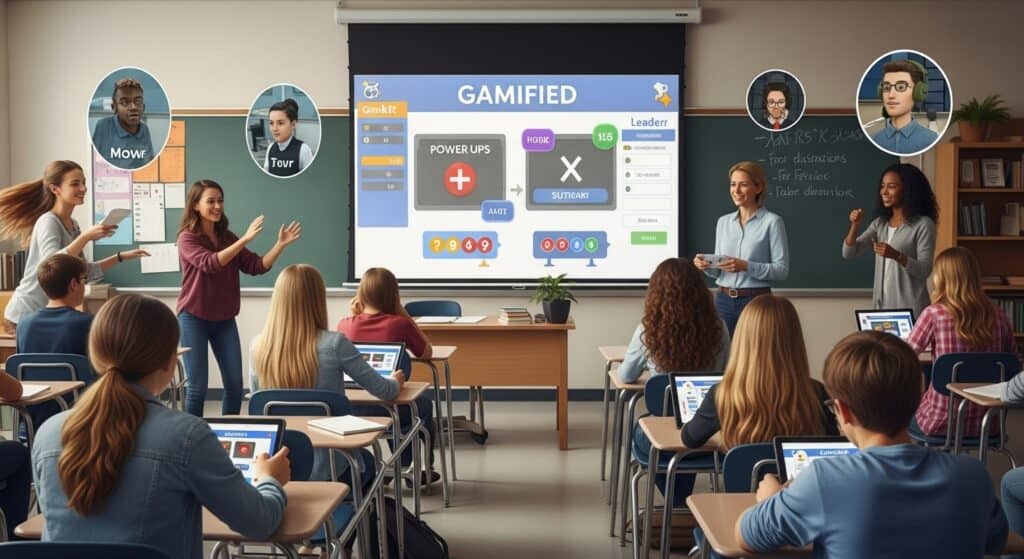
Last year, on the second-to-last day of school, I told my worst class (34 kids, chronic behavior issues, half failing) that we weren’t playing Gimkit because we had to review for the final.
They revolted.
Not shouted. Not complained. Full revolt. “No Gimkit, no work.” They sat there. Thirty-four teenagers who couldn’t sit still for five minutes suddenly united in protest.
I gave in. We played. They got the highest final exam average of any class I taught that year.
That’s engagement.
Not the fake kind where they smile and nod.
The real kind where they care enough to fight for it.
That’s why, after every shiny new tool has come and gone, Gimkit is still the one I open every week.
Because it doesn’t just keep kids busy.
It makes them want to be there.
And in 2025, with attention spans shorter than ever, that feels like actual magic.